Have you ever dreamed of crafting a Pilsner that rivals the legendary Pilsner Urquell, a beer whose very name, “source” in German, signifies its foundational role in a global style? The pursuit of brewing such an iconic lager, with its distinctive malt character, noble hop aroma, and crisp finish, is a challenging yet deeply rewarding endeavor for any seasoned homebrewer. While the original 1842 triple decoction method may seem daunting, modern techniques and precise ingredient selection can bring you remarkably close to replicating this historical brew right in your own brewhouse. The video above meticulously walks you through a comprehensive brew day for a Pilsner Urquell clone, offering practical insights into advanced homebrewing practices.
This deep dive extends beyond the visual guide, providing an intricate look at the science and art behind each critical step. We will explore how specific malt combinations can mimic historical mashing techniques, the absolute necessity of rigorous water chemistry, the nuanced role of yeast management, and the sophisticated approach to fermentation and packaging that elevates a good lager to a great one. Understanding these elements is paramount for achieving the delicate balance and clarity synonymous with a classic Pilsner. Let’s peel back the layers of this fascinating brewing journey, ensuring your next batch of Pilsner Urquell clone is nothing short of extraordinary.
Deconstructing the Mash: Beyond Triple Decoction
The traditional triple decoction mash employed by Pilsner Urquell since its inception in 1842 is a labor-intensive process, celebrated for developing a rich, complex malt character and a deep golden hue. This method involves repeatedly removing a portion of the mash, boiling it, and returning it to the main mash, which intensifies enzyme activity and promotes Maillard reactions. For many modern homebrewers, replicating this exact process can be impractical given equipment limitations and time constraints. Fortunately, a thoughtful selection of malt varieties can effectively mimic these deep, malty flavors, acting as a shortcut to that desired complexity without the historical rigor.
Our brew day begins with 55 liters of tap water, adjusted to an optimal mash pH of 5.49 using just 6 milliliters of lactol. Precise pH control is akin to setting the stage for a perfect play; it allows your enzymes to perform at their peak, ensuring efficient conversion of starches to fermentable sugars and contributing to both flavor stability and yeast health. The malt bill itself, totaling 12.38 kilograms, is a masterclass in subtlety: 9.9 kg (80%) BestMalz Pilsen Malt forms the clean, crisp base, while 1.24 kg (10%) BestMalz Vienna, 620 g (5%) BestMalz Caramel Pils, and 620 g (5%) BestMalz Munich contribute layers of bready, nutty, and slightly caramelized notes. This particular blend, with its higher percentage of specialty malts compared to a pure Pilsner malt bill, is specifically designed to replicate the depth a decoction mash would typically provide, offering a richer, more complex profile.
The Finer Points of Malt Processing and Water Treatment
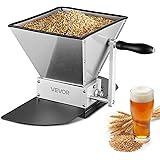
A crucial element in maximizing extract efficiency, especially with a simplified mash regimen, is the malt crush. The video demonstrates a finer crush of 1.2 millimeters, a strategic adjustment aimed at improving yield. This finer grind breaks down the malt kernels more thoroughly, exposing more surface area for enzyme action during mashing. However, it’s a delicate balance, as an excessively fine crush can lead to a “sticky mash” or a “stuck sparge,” where the water struggles to flow through the compacted grain bed. This can be compared to trying to drain water through finely ground coffee versus coarse grounds—the resistance is significantly higher. Brewers often counteract this by adding rice hulls to the mash, which create channels for liquid flow.
Beyond pH, mineral additions play an equally significant role in sculpting the beer’s character. For this Pilsner Urquell clone, a modest 2.5 grams each of calcium chloride and gypsum were added. These brewing salts are not merely pH adjusters; they provide essential ions that contribute to yeast vitality, improve protein coagulation for clearer beer, and enhance specific flavor profiles. Calcium ions, for instance, are vital for enzyme function during the mash and promote flocculation of yeast during fermentation. Chloride tends to accentuate malt sweetness and body, while sulfate from gypsum sharpens hop bitterness, creating a more defined and crisper finish. The strategic addition of these salts, particularly on top of the grain bed with a bit of cold water to aid dissolution, ensures they integrate effectively throughout the mash, preventing them from settling inertly at the bottom of the mash tun.
Sparge, Boil, and Hop Schedule: Crafting Bitterness and Aroma
Once the mash concludes, typically after an hour or more at 67°C followed by a 10-minute mash out at 78°C, the clear wort must be separated from the spent grains through sparging. This process rinses the remaining sugars from the malt, maximizing the yield of fermentable liquid. The video showcases an efficient sparge setup using an SS Brewtech system and a Riptide pump, allowing for precise control over the water flow. Achieving a target sparge volume of 73-75 liters is critical for hitting the desired original gravity and overall batch size. Without internal volume markings on the Braumeister, the brewer cleverly uses a physical measurement—6 centimeters from the top of the wort—as a reliable indicator, a pragmatic solution to a common equipment challenge.
The boil phase, an 80-minute marathon for this Pilsner, is where hop character truly shines and the wort undergoes vital transformations. Before the boil even begins, a small dose of anti-foam is introduced. This “cheap insurance” prevents the notorious “boil over”, saving countless hours of messy cleanup and preserving precious wort. The hop schedule for this Pilsner Urquell clone relies exclusively on Saaz hops, the quintessential noble hop variety known for its delicate, earthy, and spicy aroma. The original recipe calls for 100 grams of Saaz at 3.8% alpha acid for a total of 38 IBU (International Bitterness Units). However, recognizing that alpha acid content varies between hop batches, the brewer accurately adjusts the first hop addition to 85.4 grams of 4.02% alpha acid Saaz to achieve the same 17 IBU contribution, maintaining the targeted bitterness profile. This demonstrates an expert-level understanding of hop utilization and recipe adaptation, ensuring the beer’s bitterness aligns perfectly with the classic Pilsner Urquell character.
Refining the Boil: Clarity and Yeast Nourishment
Subsequent hop additions further build the intricate Saaz profile: 100 grams at 45 minutes for 12 IBU, and another 100 grams at 25 minutes for 9 IBU. These later additions contribute more to flavor and aroma than bitterness, layering the beer with that unmistakable noble hop essence. As the boil nears its end, at the 15-minute mark, two crucial additions are made. First, two Whirlfloc tablets are added. Whirlfloc, a carrageenan-based fining agent, acts like a magnet, attracting and precipitating haze-forming proteins during the cold break, resulting in a brilliantly clear finished beer. Secondly, a teaspoon of yeast nutrients, dissolved in cold water to ensure even distribution, is added. This provides essential micronutrients for the yeast, preparing them for a robust and healthy fermentation, especially critical for lager yeasts which can be more finicky.
The final 15 minutes of the boil also serve a dual purpose: sanitizing the wort chiller and initiating a whirlpool. The ZChiller’s counterflow chiller is activated, pumping hot wort through it to sterilize its internal surfaces, while simultaneously creating a vigorous whirlpool within the kettle. This whirlpool effect, much like swirling a cup of coffee to gather the grounds, causes hot break material, hop trub, and other undesirable solids to coalesce into a compact cone in the center of the Braumeister. This neat separation ensures that only clear wort is transferred to the fermenter, preventing off-flavors and promoting superior clarity in the final Pilsner. Cooling the wort down to pitch temperature, ideally 12°C, is then handled by the chiller, often with assistance from a glycol chiller to reach precise lager fermentation temperatures.
The Heart of Lager Brewing: Yeast and Fermentation Mastery
The true soul of any lager, particularly a Pilsner Urquell clone, lies within its yeast. The video emphasizes the critical role of WLP802 Czech Budějovice Lager yeast, often considered the gold standard for replicating authentic Czech lagers. Unlike ale yeasts, lager yeasts require specific conditions, most notably a lower fermentation temperature, to produce their clean, crisp, and sulfur-tinged profile. To ensure a healthy and vigorous fermentation, a substantial yeast starter is prepared over two steps, building up to 1240 billion yeast cells, or 1.49 million cells per °P (degrees Plato). This overbuilding strategy, including an extra 200 billion cells, is a best practice for lagers, ensuring sufficient yeast to handle the cooler temperatures and longer fermentation times. Decanting the starter, pouring off the “starter beer,” is essential to prevent unwanted flavors from the starter media from impacting the main batch.
Before pitching, the yeast starter is sampled to check for any off-flavors or infections, acting as a final quality control gate. A clean, healthy starter is paramount, as an infected starter could ruin an entire batch. Once deemed ready, the yeast is repitched into freshly chilled wort, which helps to rouse and activate the yeast cells. Oxygenation of the wort is another non-negotiable step for lagers. While shaking a plastic fermenter might suffice for some ales, lagers demand a higher concentration of dissolved oxygen to support the yeast’s initial aerobic growth phase. An Oxywand coupled with an oxygen flask ensures precise and ample oxygen infusion. This initial burst of oxygen allows the yeast to multiply robustly before switching to anaerobic fermentation, leading to a cleaner flavor profile and preventing sluggish or stalled fermentations.
Optimizing Fermentation: Pressure and Clarity
The Pilsner Urquell clone undergoes pressure fermentation, a sophisticated technique that significantly shortens the beer’s maturation time. Initially set to 0.6 bars, then increased to 0.8 bars on day 3, this controlled pressure suppresses the production of undesirable fermentation byproducts like diacetyl and acetaldehyde, which are common culprits for off-flavors in lagers. A spunding valve precisely regulates the internal pressure, allowing the beer to naturally carbonate as fermentation progresses. The decreased activity observed on the spunding valve, with fewer bubbles, signals the slowing of fermentation, a visual cue of the yeast doing its work. The flocculation of yeast, visible in the sight glass, indicates the yeast cells are clumping together and settling out, a positive sign for clarity.
To further enhance clarity and even render the beer “almost gluten-free,” 20 drops of Brewer’s Clarex are added. This enzyme breaks down haze-forming proteins, ensuring a brilliant, sparkling appearance without affecting head retention or flavor. After approximately three weeks of fermentation, the beer is ready for kegging. The fermentation process, carefully managed through temperature control via a glycol chiller and monitored by an Inkbird controller and a Tilt hydrometer, exemplifies modern precision brewing. The Tilt, constantly logging specific gravity and temperature data to Brewfather, provides invaluable insights, acting as the brewer’s eyes and ears inside the fermenter, ensuring every parameter is perfectly aligned for an exceptional Pilsner.
Kegging Day: Preserving Perfection and Achieving Ideal Carbonation
Kegging day marks the culmination of weeks of careful brewing and fermentation, a crucial stage where proper technique ensures the Pilsner Urquell clone maintains its pristine quality. The paramount concern during transfer is oxygen exclusion. Just as rust damages metal, oxygen is a mortal enemy to finished beer, especially lagers, leading to oxidation that manifests as stale, papery, or sherry-like off-flavors. To combat this, the brewer meticulously executes an oxygen-free transfer. This involves flushing kegs and hoses with CO2 using Star San solution, ensuring any residual oxygen is purged. The sight glass on the fermenter offers a visual confirmation: initially, yeast is visible, but as it’s dumped, clear beer emerges, indicating the fermenter is ready for transfer.
Before the full transfer, a small sample of the carbonated beer is taken using a specialized gadget designed to prevent a “foam party.” This allows for a preliminary taste and carbonation check. While the beer might still be a bit “fresh” from the tank, lacking the full conditioning, it confirms the absence of infections and the developing flavor profile. The transfer itself is a slow, controlled dance. The beer filter and hose are first flushed with CO2 to eliminate any trapped air. Then, with CO2 pressure applied to the fermenter (around 0.7 bars) and a spunding valve on the receiving keg, beer is gently pushed from the fermenter into the keg. The key is to slowly release pressure from the keg’s spunding valve, allowing beer to flow in without causing excessive foaming or agitation, which could introduce oxygen and compromise clarity. The scale beneath the keg ensures accurate filling, while the visibly clearer beer entering the keg highlights the success of previous fining and settling efforts.
This careful process, observed as the beer slowly fills the keg, ensures that the hard-won clarity, flavor, and carbonation achieved during fermentation are perfectly preserved. Once kegged, the beer can undergo final carbonation adjustments as needed, further conditioning to reach its peak expression. The meticulous approach to brewing Pilsner Urquell, from malt selection and water chemistry to yeast management and oxygen-free kegging, demonstrates that replicating a legendary beer is an intricate art, demanding both technical prowess and a deep appreciation for the craft.
Tapping Into Your Pilsner Urquell Brewing Q&A
What kind of beer is a Pilsner Urquell clone?
A Pilsner Urquell clone is a homemade beer designed to taste like the original Pilsner Urquell, a famous Czech lager known for its crisp, malty, and hoppy flavors.
Why is brewing a Pilsner Urquell clone considered challenging?
It’s challenging because it requires precise control over ingredients, water chemistry, specific fermentation temperatures, and advanced techniques like oxygen-free packaging to achieve the classic taste.
What type of hops are typically used for a Pilsner Urquell clone?
This recipe exclusively uses Saaz hops, a classic noble hop variety known for its delicate, earthy, and spicy aroma, which is essential for a true Pilsner.
What is the importance of yeast for this type of lager?
The correct yeast, like WLP802 Czech Budějovice Lager yeast, is crucial because lager yeasts ferment at lower temperatures and produce the clean, crisp, and authentic flavor profile specific to Czech lagers.
Why is it important to prevent oxygen from touching the beer when putting it into a keg?
Oxygen is harmful to finished beer, especially lagers, as it can cause oxidation, leading to undesirable stale, papery, or sherry-like off-flavors.