The landscape of beverage consumption has seen a notable shift in recent years, with a growing interest in non-alcoholic (NA) alternatives. Consumers are increasingly seeking options that deliver complex flavors and a satisfying experience without the alcohol content. However, the quality of commercially available non-alcoholic beer has often been perceived as inconsistent, leaving many enthusiasts searching for better tasting options.
Furthermore, while hop water has emerged as a palatable low-alcohol substitute, its commercial pricing can be surprisingly high, sometimes even exceeding that of traditional IPAs. As demonstrated in the accompanying video, an innovative approach to crafting delicious homemade non-alcoholic beer has been discovered, addressing both taste and cost concerns effectively. This method offers a compelling alternative for homebrewers who wish to enjoy the nuanced profiles of craft beer while managing alcohol intake.
Understanding the Challenge of Crafting Quality Non-Alcoholic Beer
The journey to creating truly enjoyable non-alcoholic beer is often fraught with difficulties, frequently resulting in products that lack body, flavor, or aromatic complexity. Many traditional methods for producing NA beer involve removing alcohol from fully fermented beer, which can unfortunately strip away delicate flavors and aromas. Consequently, the resulting beverage may taste thin or artificial, falling short of expectations for discerning palates.
Conversely, the simplicity of hop water production, involving just hops and water, tends to yield a more reliable and often quite refreshing outcome. Yet, as noted, the cost of commercial hop water, such as Lagunitas’ offering at approximately $9 per four-pack, can be a significant deterrent. This economic factor has prompted many homebrewers to explore DIY solutions, inadvertently leading to new discoveries in the realm of non-alcoholic beer.
The Accidental Discovery: From Hop Water to NA Beer Innovation
An interesting development arose from attempts to improve homemade hop water, which initially involved merely boiling hops in water. This basic technique often produces a somewhat “rough” flavor profile, lacking the depth typically found in well-crafted beverages. A pivotal enhancement was introduced by naturally carbonating hop water through the addition of a small amount of dextrose or dry malt extract and a minimal quantity of yeast.
This process was found to dramatically improve the hop water, softening the hop bitterness and imparting additional layers of flavor. The yeast’s mild fermentation not only created natural carbonation but also contributed a subtle complexity that was greatly appreciated. This significant improvement in taste and mouthfeel established it as the preferred method for producing hop water, which inadvertently paved the way for the creation of an exceptional non-alcoholic beer.
The Parti-Gyle Mash Technique for Non-Alcoholic Beer
The accidental breakthrough in producing delicious non-alcoholic beer was achieved through an innovative application of the parti-gyle mash technique. Traditionally, a parti-gyle mash involves collecting a second, weaker wort from the same grain bed after the first runnings have been collected for a primary beer. This secondary wort is then used to brew a lower-gravity beer, often referred to as a “small beer” or “table beer.”
In this specific application for non-alcoholic beer, the method involved sparging spent grains from a regular brew day with warm water. As discussed in the video, approximately five and a half gallons of water, around 120-some degrees Fahrenheit, were slowly poured over the drained grains. This gentle rinse extracted residual fermentable sugars, non-fermentable sugars, and malty flavors that would otherwise be discarded, forming the basis of the NA beer.
The goal was to collect just enough fermentable sugar to facilitate natural carbonation in the hop water. However, the parti-gyle mash unexpectedly yielded a much richer liquid, imbued with significant flavor and depth from the grains. Consequently, this liquid presented more like a light, hoppy beer than a simple hop water, signifying the creation of a unique non-alcoholic beer alternative.
Achieving True Non-Alcoholic Status: Managing ABV
A crucial aspect of producing a legally defined non-alcoholic beer is maintaining an alcohol by volume (ABV) of 0.5% or less. While the natural carbonation process involving yeast and sugar does produce a small amount of alcohol, careful control is required to stay within this limit. Hop water, by contrast, typically contains zero percent alcohol, offering a distinct difference in classification and consumption considerations.
To ensure the parti-gyle mash non-alcoholic beer remains below the 0.5% ABV threshold, specific attention must be paid to the initial mash parameters. It is advised that the primary beer from which the spent grains are sourced should be about 5% ABV or less. This helps in controlling the amount of residual sugar remaining in the grains for the secondary parti-gyle mash, preventing an overproduction of alcohol.
Furthermore, aiming for a starting gravity (specific gravity before fermentation) of approximately 1.005 for the parti-gyle wort is critical. This seemingly low gravity ensures there is sufficient sugar for natural carbonation without exceeding the target ABV. Rigorous adherence to this initial gravity measurement is paramount for brewers committed to producing a genuine non-alcoholic product.
The Brewing Process for Parti-Gyle Non-Alcoholic Beer
Once the parti-gyle wort has been collected, the subsequent steps in brewing this unique non-alcoholic beer are relatively straightforward. The process is designed to be accessible to homebrewers already familiar with basic brewing practices, albeit with a few crucial distinctions.
Boiling and Hopping
The collected wort should be brought to a boil, similar to a standard beer brewing process. During this stage, hops are added to impart the desired aroma and bitterness. While experimental hop schedules are encouraged, a general guideline suggests using five ounces of hops or less for this recipe. Exceeding this amount could result in an excessively harsh or unbalanced hop profile for such a light-bodied beverage.
Chilling and Yeast Pitching
After the boil, the wort must be rapidly chilled to an appropriate temperature for yeast pitching. Aeration of the chilled wort is also important, as yeast requires oxygen for healthy cell growth during the initial fermentation phase. Only a small amount of yeast is needed for this process, and any variety can be utilized, providing flexibility for the brewer to experiment with different flavor contributions. However, the primary role of the yeast here is carbonation, not significant alcohol production.
Sealed Fermentation and Carbonation
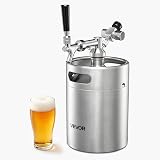
A key procedural difference for this non-alcoholic beer involves the fermentation vessel. Unlike typical beer fermentation that often utilizes an airlock to release CO2, this method explicitly requires the wort to be placed in a sealed keg. The absence of an airlock ensures that the CO2 produced during the yeast’s minimal fermentation activity is trapped within the keg, thereby naturally carbonating the beer.
The sealed keg should be left at room temperature for approximately two weeks to allow the natural carbonation process to complete. Following this fermentation period, the keg is transferred to a kegerator or similar chilling unit to bring the beer down to serving temperature. It is generally advisable to be conservative with the initial CO2 levels; if the beer is not sufficiently carbonated, forced carbonation from a CO2 tank can be easily employed to achieve the desired fizziness. This flexible approach ensures that the final product meets personal carbonation preferences without the risk of over-carbonation from the natural process.
Crafting Good NA Beer: Your Questions Answered
What is non-alcoholic (NA) beer?
Non-alcoholic beer is a beverage that tastes like traditional beer but contains very little alcohol, typically 0.5% alcohol by volume (ABV) or less. It provides a flavorful drink option without the intoxicating effects.
Why make non-alcoholic beer at home instead of buying it?
Homemade non-alcoholic beer can offer better taste and more consistent quality than many store-bought options. It also helps save money, as commercial low-alcohol alternatives can be quite expensive.
What is the ‘parti-gyle mash’ method used for this non-alcoholic beer?
The parti-gyle mash method involves using leftover or ‘spent’ grains from a regular beer brewing process. Warm water is poured over these grains to extract residual sugars and flavors, forming the base for the non-alcoholic beer.
How is the non-alcoholic beer kept below 0.5% alcohol content?
It’s kept low by using spent grains from a primary beer that was 5% ABV or less and aiming for a very low amount of fermentable sugar in the NA wort. This ensures minimal alcohol production while still allowing for natural carbonation.